
Tile Shade Variation, Batch Numbers & Caliber: What Importers Should Know Before Ordering
Two boxes of tiles may carry the same product name, size and finish but still look slightly different when installed next to each other.
For a homeowner buying a few boxes, this might be a minor inconvenience. For an importer supplying thousands of square metres to a construction project, it can become a costly problem.
Shade differences, production batches and dimensional variations are often overlooked during procurement. Yet these details can affect the final appearance of a floor, the consistency of a shipment and the outcome of a customer complaint.
Understanding how manufacturers identify and control these variations can help buyers make better purchasing decisions.
This guide explains what tile shade variation, batch numbers and caliber mean, why they matter and what international buyers should check before confirming a bulk order.
What Is Tile Shade Variation?
Tile shade variation refers to differences in colour, tone, pattern or texture between individual tiles, even when they belong to the same product collection.
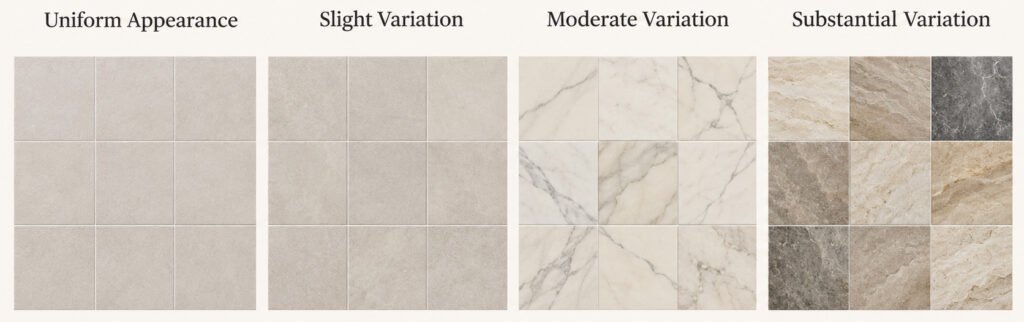
These differences may be intentional, as in marble-look porcelain tiles, or may result from variations between manufacturing runs.
During ceramic and vitrified tile manufacturing, factors such as raw material composition, pigments, glazing and firing conditions can influence the finished appearance.
Modern digital printing technology also allows manufacturers to produce multiple design faces within a single tile collection. This helps create a more natural appearance, particularly in products designed to resemble marble, granite, travertine or wood.
As a result, not every visible difference should be treated as a manufacturing defect.
The important question is whether the variation falls within the product’s intended appearance and the specifications agreed upon before purchase.
Understanding Tile Shade Variation Ratings: V1 to V4
Tile manufacturers & suppliers commonly use a shade variation classification to indicate how much visual difference buyers should expect between tiles. The familiar V1–V4 scale helps distinguish relatively uniform designs from collections with more pronounced variation.
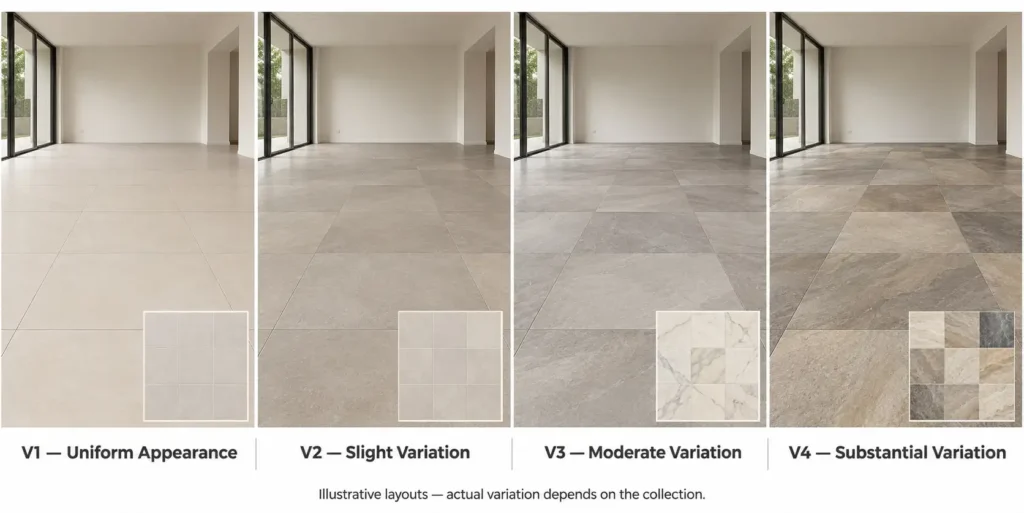
V1 — Uniform Appearance
V1 tiles have minimal differences in colour and texture between individual pieces.
They are often preferred for projects where visual consistency is important, such as institutional interiors, minimalist commercial spaces or areas requiring a uniform background.
However, V1 does not guarantee an exact colour match between separate production batches.
V2 — Slight Variation
V2 tiles show subtle differences in tone, pattern or surface texture.
These variations can add depth without creating a strongly contrasting appearance.
They are suitable for many residential and commercial applications where designers want some visual interest while maintaining an overall consistent colour scheme.
V3 — Moderate Variation
V3 tiles feature noticeable differences between individual pieces.
A marble-look porcelain collection, for example, may contain tiles with different vein arrangements or variations in background colour.
For these products, reviewing one sample tile is rarely enough to understand the finished installation. Buyers should examine multiple pieces or a representative layout before approving the design.
V4 — Substantial Variation
V4 tiles may display significant differences in colour, texture or pattern.
This category is commonly associated with designs intended to reproduce the varied appearance of natural materials.
For projects using V4 tiles, the overall combination of pieces matters more than the appearance of any single tile.
A representative layout is particularly important when the final design requires a balanced distribution of contrasting colours or patterns.
Does a Higher Variation Rating Mean Better Quality?
No. Shade variation ratings describe appearance, not manufacturing quality. A V4 tile is not automatically better than a V1 tile, nor is a V1 tile necessarily more durable. The appropriate classification depends on the architectural design, customer expectations and intended application. For importers, the main consideration is whether the product’s actual visual variation matches the approved sample and agreed specification.
Does a Higher Variation Rating Mean Better Quality?
No.
Shade variation ratings describe appearance, not manufacturing quality.
A V4 tile is not automatically better than a V1 tile, nor is a V1 tile necessarily more durable.
The appropriate classification depends on the architectural design, customer expectations and intended application.
For importers, the main consideration is whether the product’s actual visual variation matches the approved sample and agreed specification.
What Is a Tile Batch Number?
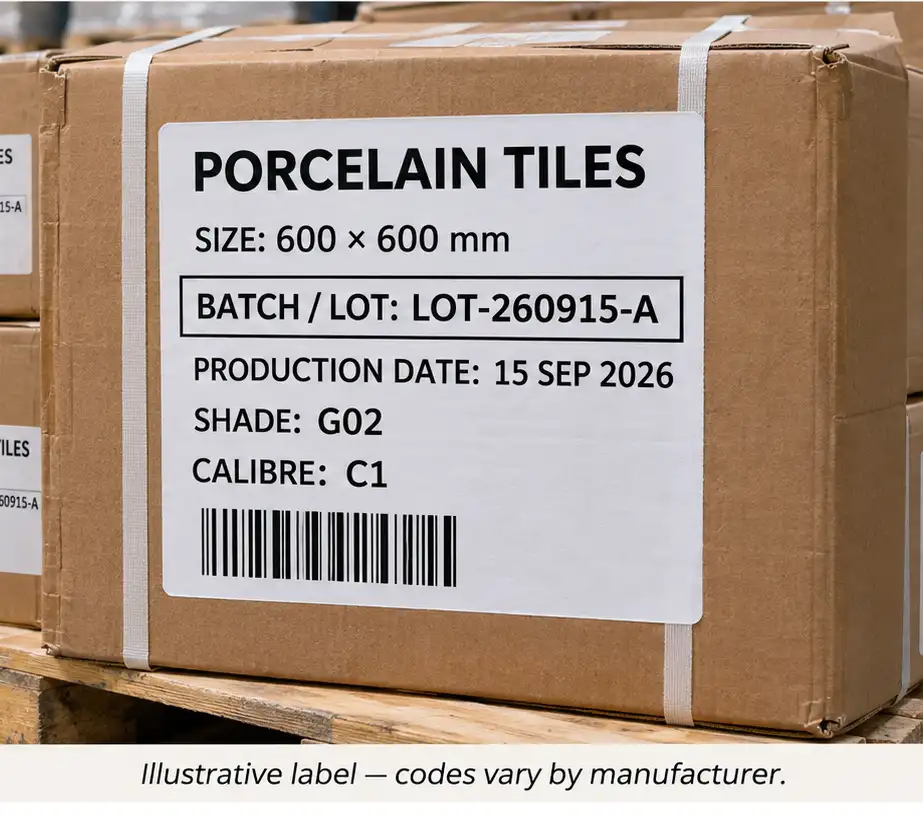
A tile batch number is a production identification code used to help trace tiles to a particular manufacturing run or production group.
Depending on the manufacturer, carton labels may identify the batch through a production date, lot number, shade code or another internal reference.
These codes are particularly important when purchasing large quantities of ceramic, porcelain or vitrified tiles.
Why Do Production Batches Matter?
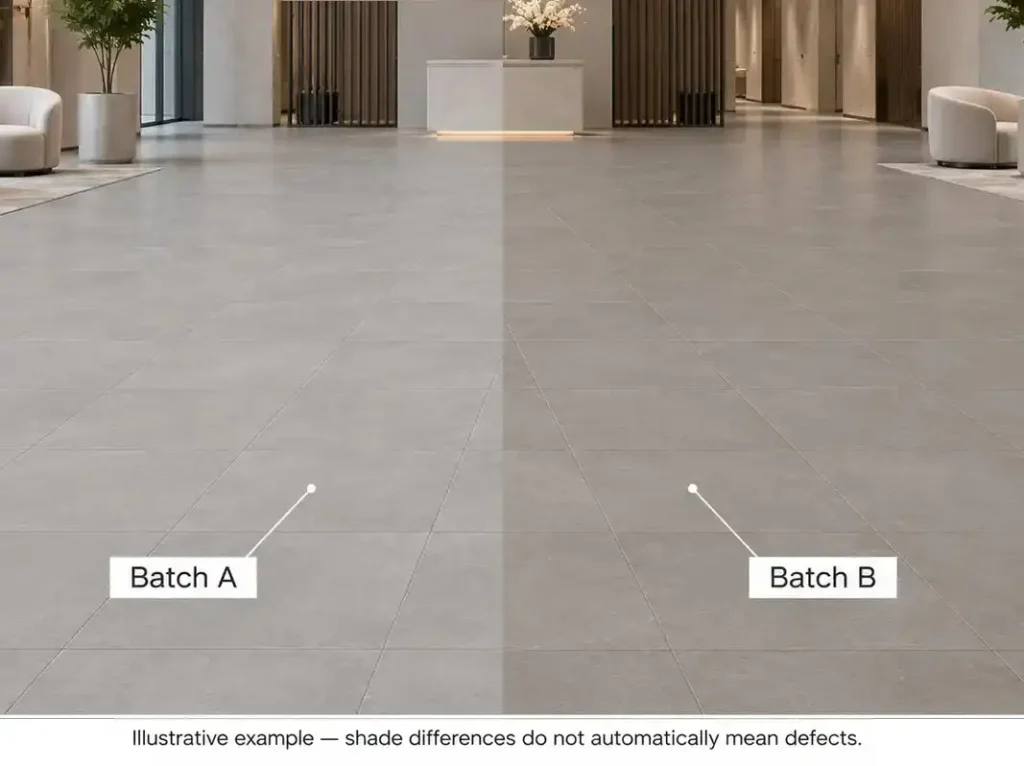
Imagine an importer ordering 2,000 square metres of grey porcelain tiles for a hotel project.
The first shipment contains 1,500 square metres. A few weeks later, the remaining 500 square metres arrive from a different production batch.
Although both shipments contain the same tile design, a slight shade difference may become noticeable when the tiles are installed together under consistent lighting.
This does not automatically indicate defective manufacturing. However, it can create an undesirable visual result.
For projects requiring continuous flooring across large areas, buyers should discuss batch consistency before production and shipment.
Can Tiles from Different Batches Be Mixed?
Sometimes, but not without checking.
Tiles from different production batches should be compared under appropriate lighting before installation.
If the difference is noticeable, it may be preferable to allocate separate batches to different rooms or clearly divided installation areas.
This is crucial for large open-plan interiors where a continuous floor can make shade differences clearly visible.
For repeat orders, importers must confirm the availability of the original batch.
If it does not, a fresh sample or representative batch comparison may be needed before approving additional stock.
What Does Tile Caliber Mean?
In tile manufacturing, caliber generally refers to a dimensional grouping used to identify tiles with closely matched actual sizes.
Ceramic tiles may undergo small dimensional changes during manufacturing and firing.
To manage these differences, some manufacturers sort tiles into dimensional groups.
These groups may be identified through caliber codes printed on the cartons.
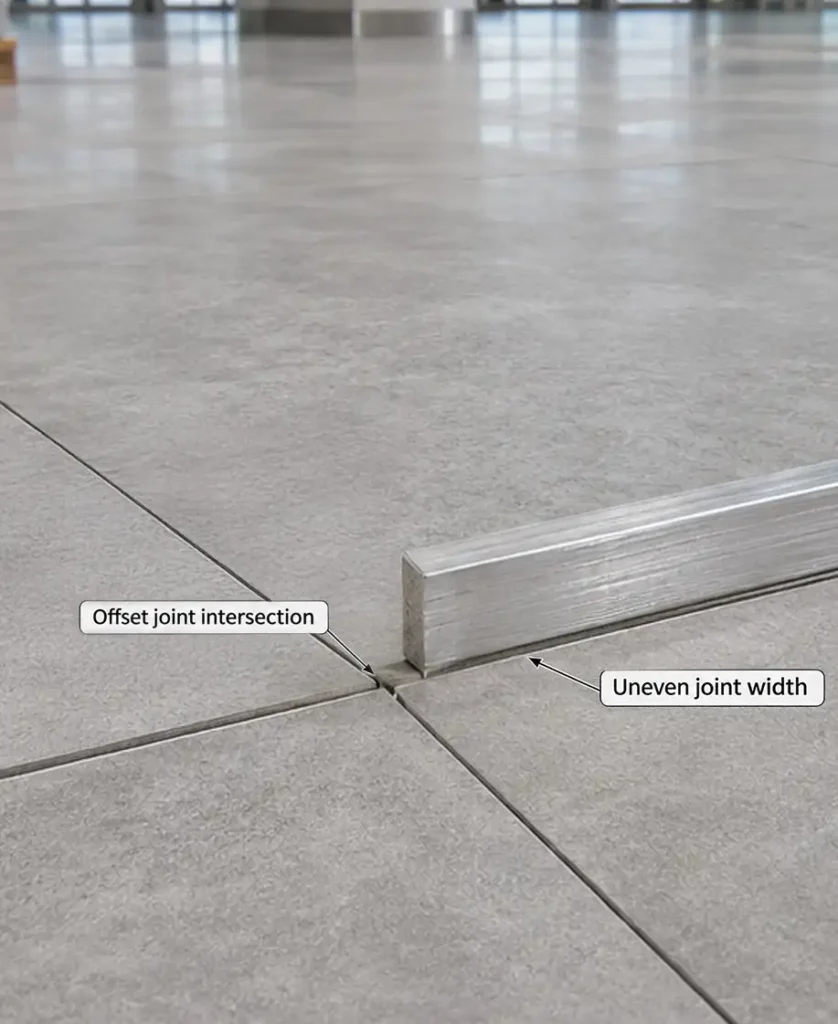
Why Is Caliber Important?
Consider a large commercial flooring project using nominal 600 × 600 mm tiles.
If tiles from different dimensional groups are mixed without proper planning, installers may encounter differences that affect joint alignment & the overall appearance.
Even relatively small size variations can become noticeable across a large installation.
Therefore, buyers should confirm whether the selected product uses caliber identification and whether all cartons intended for the same continuous installation have compatible dimensions.
Is Caliber the Same as Tile Thickness?
No.
Caliber generally concerns dimensional grouping, particularly length & width.
Thickness is a separate technical characteristic and should be checked against the relevant product specification.
Both are important when evaluating tiles for large commercial projects.
Rectified vs Non-Rectified Tiles: Why the Difference Matters
Another important consideration is whether the selected tiles are rectified.
Rectified tiles have their edges mechanically finished after firing to achieve more consistent dimensions.
This makes them suitable for installations that require precise alignment and relatively narrow grout joints.
Non-rectified tiles retain their manufactured edges and may require different joint arrangements depending on their dimensional characteristics.
However, rectification does not mean tiles can be installed without grout joints.
Appropriate joint widths, installation tolerances and movement joints still need to follow the applicable installation requirements.
For importers purchasing large-format porcelain or vitrified tiles, confirming whether a product is rectified can help avoid misunderstandings during project planning.
How Can Importers Check Tile Quality Before Shipment?
Visual appearance is important, but it is only one part of tile quality.
For international buyers, the most effective approach is to combine sample approval with technical documentation and production-level quality checks.
1. Request Samples
A single tile may not reveal the full appearance of a collection. For designs with moderate or substantial variation, ask for several pieces showing different patterns or shades. The samples should represent the product that will be supplied in the final order.
2. Confirm the Exact Product Specification
The purchase order should identify more than the product name. It should include the tile code, nominal size, finish, thickness, edge type and intended application. Wherever relevant, the agreement should also clearly state acceptable visible variation & any project-specific dimensional requirements.
3. Review Technical Test Reports
Buyers must ask for appropriate test reports for the intended application.
ISO 13006 provides a classification framework for ceramic tiles, while the ISO 10545 series includes methods for testing characteristics such as water absorption, dimensions and mechanical performance.
The applicable requirements depend on the product category and destination market.
For flooring exposed to moisture, buyers should also review appropriate slip-resistance information rather than assuming that a matte finish is automatically suitable.
4. Check Carton Identification
Before dispatch, confirm that the packing details clearly identify the supplied products. Wherever applicable, carton labels should mention the product code, size, shade or batch identification, caliber & quantity. The precise label format may vary between manufacturers.
5. Arrange Pre-Shipment Inspection
For substantial orders, buyers may consider a documented pre-shipment inspection. This can include checking samples from the packed goods, verifying product identification, reviewing packaging condition & comparing the shipment against the approved specifications. Where independent verification is required, the buyer and supplier should agree on the inspection scope & acceptance criteria in advance.
6. Examine Export Packaging
Tiles must travel through several handling stages before reaching the destination warehouse.
Poor packaging or inadequate cargo securing can increase the risk of breakage, even when the tiles themselves meet the required standards.
Importers should discuss carton protection, pallet arrangements, loading methods and handling requirements before dispatch.
What Should a Bulk Tile Purchase Order Include?
A well-prepared purchase order can prevent many common misunderstandings.
For ceramic and vitrified tile imports, buyers should consider documenting the following:
● Product code, description and approved sample reference
● Nominal size, actual dimensional requirements & thickness
● Surface finish, edge type and intended application
● Acceptable shade variation and relevant batch or caliber requirements
● Applicable technical standards and test reports
● Inspection procedure, acceptance criteria & claim process
● Quantity, packing configuration, carton identification
● Delivery terms, shipping documents and agreed dispatch schedule
Not every project needs identical requirements.
A residential wall tile order and a large commercial flooring project may involve different performance expectations.
The objective is to make the specifications clear enough that both buyer and supplier understand what constitutes an acceptable shipment.
How Can Buyers Reduce Shade-Matching Problems?
One of the simplest ways to reduce shade-related issues is to plan the total material requirement before placing the order.
Where practical, the quantity required for a continuous installation should be sourced from a compatible production batch.
Buyers should also account for a suitable allowance for cutting, breakage and future repairs, based on the project layout and installation requirements.
For patterned porcelain tiles, review the number of available design faces and how they are intended to be arranged.
A collection with several different faces may create a more natural installation, but it requires careful sample approval.
Finally, maintain records of approved samples, product references and shipment details.
These records become particularly valuable when placing repeat orders or investigating differences between delivered materials.
How Regatta Tiles Supports International Tile Buyers
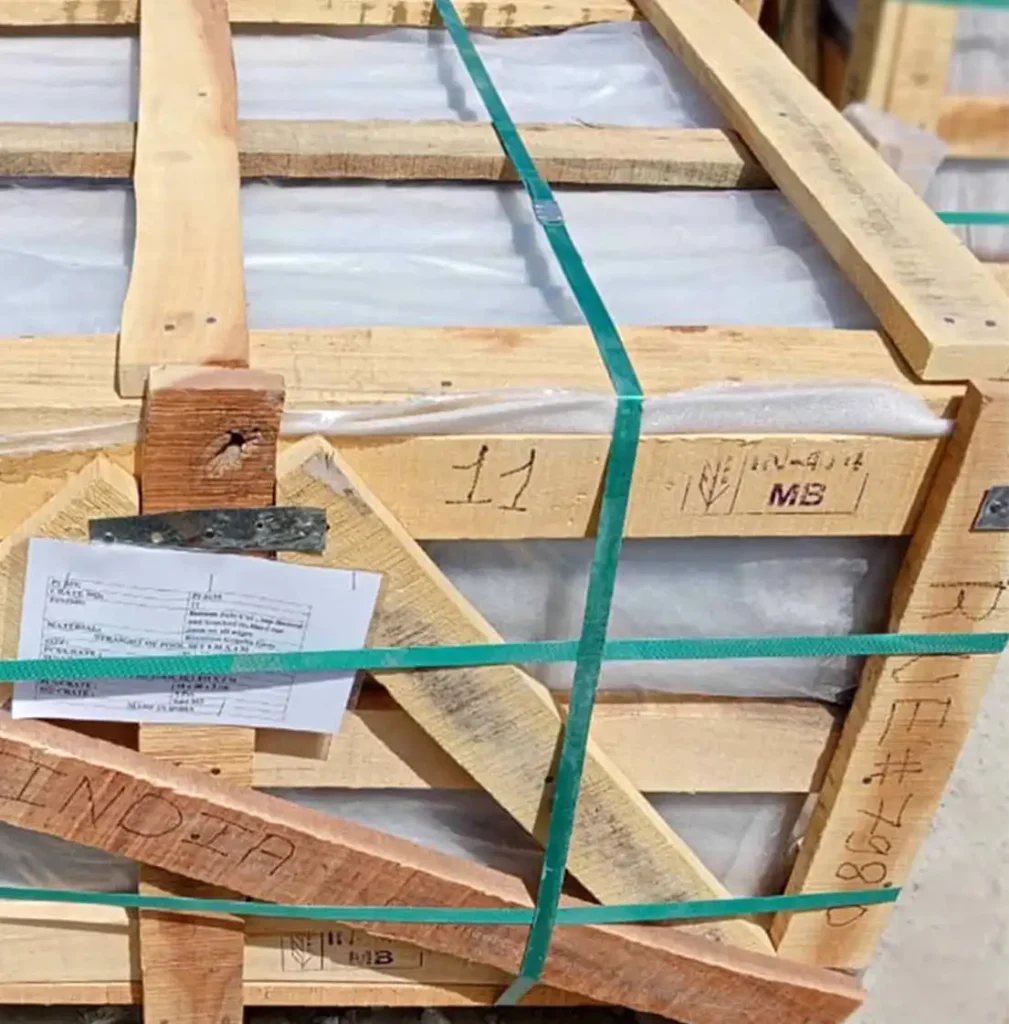
Choosing tiles for an international project involves more than selecting an attractive design.
Buyers also need dependable product identification, clear specifications and suitable export arrangements.
Regatta Tiles supplies ceramic, porcelain and vitrified tiles from India, with manufacturing operations in Morbi, Gujarat.
Its product range includes different sizes, finishes and designs for residential and commercial applications.
International buyers can discuss product samples, technical documentation, packaging requirements and export arrangements with the Regatta Tiles team before confirming an order.
This approach helps establish clear expectations for the product and its intended application.
For importers, distributors and project buyers, the right specifications can be just as important as the right design.
Frequently Asked Questions
1. What is the difference between tile shade variation & batch variation?
Shade variation refers to differences in the appearance of tiles within the same collection. Batch variation refers to differences that may occur between separate production runs. A tile collection can have intentional shade variation while also showing production-related differences between batches.
2. Are tiles with different batch numbers defective?
Not necessarily. Different batch numbers indicate separate production groups or runs. Tiles from those batches may still be compatible, but their appearance & dimensions should be checked before they are mixed in one installation.
3. Is V4 tile shade variation suitable for commercial projects?
It can be, depending on the design or project requirements. V4 indicates substantial visual variation rather than a specific level of technical performance. Buyers should evaluate the overall appearance & confirm that the product meets the relevant performance specifications.
4. Do rectified tiles have the same dimensions?
Rectification improves dimensional consistency, but manufactured products remain subject to specified tolerances. Buyers should review the applicable dimensional requirements rather than assuming that every tile is mathematically identical.
5. What should importers check before buying vitrified tiles from India?
Importers should verify product specifications, intended applications, samples, technical test reports, batch identification, packaging & other agreed inspection requirements. These checks help them minimize the risk of mismatched products & shipment-related disputes.
6. Can Regatta Tiles provide tile samples and technical information?
Regatta Tiles states that it offers physical samples and can provide technical reports covering properties such as water absorption, breaking strength and friction characteristics. Buyers should confirm the availability of reports for their selected product.
Final Thoughts
A tile can look excellent in a catalogue and still cause problems if its production details are overlooked.
For importers, understanding shade variation, batch identification and dimensional consistency makes it easier to evaluate samples, communicate expectations & manage repeat orders.
These considerations are particularly important when sourcing large quantities of porcelain and vitrified tiles for commercial developments, hotels, retail spaces and residential projects.
The best purchasing decisions combine appearance, performance and clearly documented specifications.
Planning a bulk tile order from India?
Explore the ceramic and vitrified tile collections at Regatta Tiles or contact our team to discuss product specifications, sample requirements and export enquiries.